
How to Chew Coca Leaves
You grind them into to powder then snort them up your nose! Well, of course not. Although many people make the mistake, the centuries-old tradition of chewing coca leaves has absolutely nothing to do with cocaine. In their natural form, coca leaves provide nothing more than a mild stimulant, akin to coffee. Brewing the leaves into tea is popular among all levels of Bolivian society, but among the working class, and especially for those whose labor is physically demanding, coca is usually chewed.
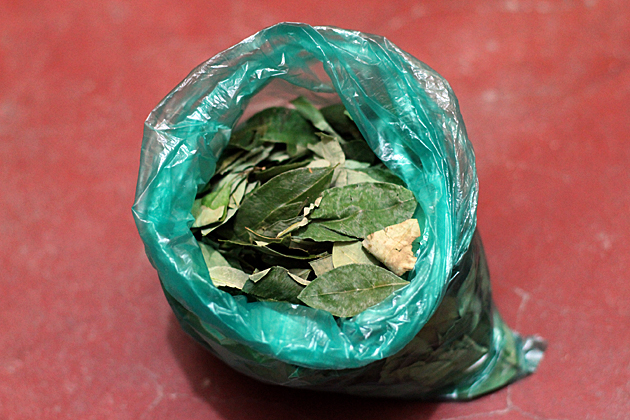
While “chewing” is the popular term for it, the leaves should never actually be munched upon. Instead, they should be placed one-by-one into the cheek, forming a small saliva-generating ball which you just leave there. Because the stems of the leaves can hurt the inside of your cheek, you should remove them first. Some remove the stems by sliding the leaves between their two front teeth, while others use a lick-fold-tear method.
After you’ve got a good amount of leaves squirreled away inside your cheek, you need to activate the alkaloids inside them to feel any effect. Some people use bicarbonate powder, but a more pleasant option is lejía: a sweet-tasting combination of ash and flavor. A tiny nip every fifteen minutes or so, and the mild stimulant effects of the coca can last for hours.
Chewing coca leaves acts as an appetite suppressant, helps with altitude sickness, provides energy and improves digestion. It also mildly numbs your cheek. It’s impossible to get “addicted” and they don’t provide any sort of high. Making cocaine out of coca leaves is a complicated, chemical process, and chewing the leaves is no more an act of “drug consumption” than eating a poppy-seed bagel.
While we were on the ferry over to the Isla del Sol, we were subjected to a monologue from a self-impressed British guy wearing colorful over-sized sunglasses and a shark’s tooth necklace. All the awesome places he’s been! All the incredible things he’s done! He had a bag of coca with him, and shoved a handful into his mouth, actually chewing them like a cow chews grass. As he did so, he bragged about how awesome coca was and how he felt an instant buzz. We had to stifle our urge to push him off the boat. Please, don’t be that guy.
Further reading: The Unfairly Maligned Coca Leaf



I have told that this leaf can cure all types of ailments. Insomnia, depression, ADD etc. I am interested in finding out whether the teas or the actual leaves would be better for increasing mental focus and fighting depression. Anyone have any feedback as to which I should try?..and is there any legalities I should know about when attempting to purchase this stuff?…I really dont want the prescription drugs my doctor has to offer, but i dont want to find myself in the back of a squad car either.thanks
I think that coca tea is illegal in the USA, unless it’s been “de-cocanized”. In which case, you might as well just drink normal tea. It’s a real shame, because the leaf is great for a lot of minor problems. Chewing the leaf, in our experience, was a lot stronger — with an effect you could notice almost immediately, but drinking the tea was great too, akin to coffee. Definitely healthier than many of the drugs that doctors routinely prescribe (but if people start feeling better w/ natural products, who would buy all the wonderful medication our pharma industry produces?)
That’s why marijuana is taking so long to get legalized. The pharmaceutical companies would probably go out of Business!!
Although coca leaves will not do much for insomnia, containing various stimulating alkaloids, and known for suppressing fatigue, they would work very well for ADD. Small quantities of stimulants such as amphetamines (Adderall) are widely used in treating ADD, and the small amount (.5-1%) of cocaine in coca leaves would promote focus, concentration, and motivation. I assume they would work relatively well for depression because they would increase dopamine, which is a mood elevator in your brain.
I went to Peru last week and they also have those leaves everywhere, after landing in Cusco they said take the tea, chew some leaves, but I didn’t get any difference, maybe my appetite decrease, they are recognized by their excellent food, and I was never very hungry.. perhaps Ill continue to use them as a diet method
The assertion that chewing coca leaf has nothing to do with the absorption of cocaine is just plain silly.Once the saliva is made alkaline and thoroughly mixed with crushed (chewed) leaf at body temperature, cocaine and several other alkaloids are very rapidly released and very efficiently absorbed through the oral mucosa. It is a rapid and efficient process. No lab with beakers and flasks and organic solvents are required. That numbing sensation in your mouth? The local affect of cocaine. The CNS effects also take place of course. Chew enough leaf properly and one gets plenty of cocaine. The indigenous Bolivians I have been friends with and chewed with were very respectful of this whole process and their relationship with Mamma Coca. They typically added one or two leaves at a time to what they had in their mouths. When I chewed in this fashion, I felt wonderful, but it is true, not exactly high. The main thing I would notice was that I didn’t want anything i.e. I was content as I was.The effects of rapidly chewing huge mouthfuls of it (and yes, one does chew it; without crushing the leaf and mixing it with alkalinized saliva, no alkaloid extraction takes place), and then repeatedly chewing more and more leaves produces a very different effect. If greedy and aggressive chewing is engaged in, plenty of cocaine is released and absorbed, with all the resulting euphoria and other affects generally associated with snorting a line.When I chew in this fashion, rather than being content and experiencing a lack of wants, all I want is to chew a little more leaf. Just a little. Just one more wad. The thing is, this is how it will go all day – more, then more, then more. Hard a heck to stop. Then one feels unpleasantly wired. There is more tIndeed, I have many times experience distinctly greater cocaine effects from aggressive chewing than from snorting a line or two of the white powder. I agree that many people, even with farly aggressive chewing, do not develop a drug problem. However, even for very experienced students of consciousness and drugs, if chewing is done in this highly aggressive manner, it is indeed very, very difficult to control and drug dependency is definitely a possibility. I clearly see changes in the personality and habits of people I know that use it this way. I have been there myself more than I like to admit. It has disrupted my life and practice of mindfulness, to say the least. I find living like a lab rat desperate to keep pushing the reward bar to be a frustrating and not-so positive existence.Use this plant with respect and restraint and it is good. There are good reasons many native people consider it sacred. Use it greedily, and you might not find the same kind of experience. Either way, the often heard assertion that chewing coca involves insignificant amount of cocaine is simply not true.
I recently bought a good amount of coca leaves at a local bolivian market as I recalled enjoying them during my time in Bolivia and Peru (on treks and long bus rides) a few years back. Anyway, after chewing a half a dozen times and varying the amount of leaves and the amount of bicarbonate, I must agree with Fred. A lot of the information I read keeps saying that it’s harmless and actually healthy. Well, the debate will go on. One interesting thing I have noticed is that since chewing the leaves and feeling the numbing and stimulatory effects — I have also noticed that the lining of my inner cheek on the lower half (where I chew the leaves) feels differently than the upper lip (not as smooth/slimy). I worry a bit if there is a negative effect just as tobacco leaves cause damage to the lips/mouth/etc? I would assume the risks could be similar?Anyway, great summary Fred, to the otherwise “coca leave has nothing to do with cocaine and it’s healthy, no need to use caution, etc” Thanks for your post
Thank you for this post. I ordered some premium coca tea bags and then some coca powder. I chewed it with some bicarb. Although its a pleasant sensation, many times I feel like that lab rat pushing the reward bar. Many nights I would binge dosing one after the other staying up all night. Overall I dont believe its been a positive experience in my life.
I agree, the effect of the leaves can be just as powerful if not more. Especially if dry ground leaves are mixed with bicarb and dampened like a chew.
Vacaville@msn.com
Pingback: Plants You Can Eat That Will Get You High (Part One)
agree with comments and it should be chewed in the same sacred way as bolivians.a good substitute for betel quid (betel leaf,tobacco,areca nut and lime together.SACRED way as red wine in Church.I use fresh leaves and lime and irregularly.
Hola….i’m here in cuenca ecuador for at least two month’s now , just discoverd the mate de coca tea . great energy boost , am dipping the tea bag’s like chewing tabbaco, it work’s verry well . a little baking soda and waaalaaa !! Felizidades , me gustaba los comentos……chao for now !
I thought this was very interesting to read. I actually was just curious about whether the coca leaf was similar to cocaine stimulation if just chewed. However, I am a young cancer patient who is suffering with a great deal of pain, and although they’ve given me some “narcotic” pain killers to help, I have to almost beg to get any. So, now that I’ve read this and the stimulant affects sound similar to what my prescribed narcotics, I am actually curious as to whether this could help me (or someone like me). I would never be able to trust something I bought off the street (which I’ve never done, don’t want to do, and would probably end up with me getting shot), I really don’t know why I couldn’t grow one little plant in my own house to supplement my medications. It seems like it would never be enough to worry about turning into something like cocaine. It really pisses me off that at my young age and in my advanced invasion state that they can’t just give me whatever the hell I want and make me comfortable. Especially with something natural like this. I have more research to do, but I appreciated this and the comments. Thanks for sharing.
How are you doing with the cancer??Just was noodling around the web and saw your story.Well stranger , I care , and hope for a healthy replyBrenda in Vancouver BCNAMASTE.
I live in Montero Bolivia and work in rural communities. While delicately destemming leaf by leaf is the gentlemens way about it, mashing in handfuls of leaves, chewing a bit, and lobbing in some bico is more common. While I do enjoy the former when I have time and patience I normally just do the latter. It certainly works.
I was born in Cusco – Peru… I consume coca leaves in tea fusions as an energizer and a digestive natural recipe. Coca leaves are spiritually sacred to people in my country due to their power in healing naturally sicknesses and contain chemicals on them like everything in nature. (If you are one that likes to consume drugs… Sorry this it not it). Coca leaves contain 14 different alcaloids and one of them is the cocaine, the other 13 are not yet discovered or extracted by science… On top; it contains calcium, vitamins, minerals and others. It is at all senses a super food. The plants of coca grow at an specific climax and are mostly used by Andes populations for adjusting their bodies to complex medical behaviors due to altitude (lack of oxigen, lack of digestion, lack of heart functionality, blood circulation, joints and bones, brain functional activities and others).(According to family experience) Coca provides better fiscal capacity by normalizing the organs and the cell actitivities throughout the body and the brain… As a result… You may find a better sleep, better capacity in fisical and intellectual activities, better attitude, better sight and reflects as well as sexual capacity… I the other hand… This magic gift from earth had given amazing healing powers to natural medicine doctors from the Andes that used it for different Outher and inner body healing as well as for spiritual rituals (knowledge trespassed by word and experience through generations… that at present is mostly gone or denied by sience)Yet, for some… Coca cola is just a drink… It’s originations came from a pharmaceutical drink to solve cough and flu problems and actually included coca leaves… A magical drink not allowed by FDA was produced in Colombia until 1965 under the name of Curarina… Which was a product that healed people desauciated from deathly snake, spider, frog or any other poison… Medicine that acted as a infection healer and was said to be a possible answer to cancer even from the last stage… IT CONTAINED COCA LEAVES AS INGREDIENT.———————I am ignorant at it at some degree… as we all are at some point in this blog… But, I ask you all to stop satanizing coca leaves as it is given by nature and it is less malicious than the money interested pills given by pharmaceutic companies trying to get you addicted to purchase. ———————-I have tryed the baking soda and the coca… It is all a bluff statement in my opinion since just the baking soda damages your body and gives you the same effects alone… I believe the damages caused to you liver wi the baking soda effects the body directly and makes you feel drugged…
I am curious, could one create a growing environment in the USA where they might be able sufficiently grow coca leaves for chewing? I know the powder stuff takes a ton of plants and work, and it is a huge process. I actually have a love hate relationship with the powder stuff. Mostly hate, and I do not use it anymore. I have often seen the videos though of workers in the Andes chewing it, and it makes me think that would be a rather nice way to enjoy the coca plant without the up and down and paranoia and bloody noses. aggggg!! It would be nice each morning to clip a few leaves off a plant and enjoy a coca leaf tea, or “just a pinch between the cheek and gum” sort of deal. I am guessing that if it were possible I would have heard about it already, but I am curious. A very mild cocaine sort of high that lasts for a period of time would be nice. Perhaps, coffee is about the same?
Well, no matter what you say, I actually chew them after leaving for a few minutes to get wet in the mouth – and it works, the whole mouth gets numb and… well you know what happens then. You just have to know how to chew them right. Instead of having an hour or so just waiting…
Pingback: Nevado Sajama | Desert Mountaineer
I visited Peru recently and had a lot of coca tea, although I didn’t have altitude sickness my mom had it bad, and said that coca tea helped greatly with it! I’m pretty sure I didn’t try the leaf alone though…. should do that. Great info within the post!!! 🙂
Baking Soda activates it really quick minutes. Some guy gave me some at a party and some bakeing soda. It just made me feel good better than chewing tabacco which I do regularly and is very bad for me. I want to make the switch anyone know how I can buy some?
Pingback: Travelogue Bolivia: Salar de Uyuni, Potosí, Sucre | Nathan Lustig
My wife and I visited Cusco and Macchu Picchu last week. As soon as we got off the plane in Cusco both of us felt very sick due to altitude. When we got to our hotel we were offered coca tea and a few minutes later we felt much better. We were there for one week and every morning we took a cup of coca with breakfast. Both of us felt that our sexual performance was greatly enhanced as well. If we can get this product in the USA we certainly would use it every day.
U.S.A. SUCKS!!!!!!! I am 56 and cannot wait to move out of USA. Natural meds should be legal not matter where they come from, GOD, or your higher power, gave these NATURAL medicines to us. LET US USE THEM!!!!! Our GOVERMENT IS KILLING US WITH THESE ANIMAL TESTED DRUGS!!!!! THEY ARE MAKING BILLIONS!!!!!!! AND WE ARE ON THE HIT LIST!!!!! AMERICANS WAKE UP!!!!
how many leaves should a beginner start with? is one leaf enough? one gram? how long will it last?
I wholeheartedly concur with the sentiments expressed by Fred Runkel in his 2012 post. I have chewed coca at a rate of approximately 40 grams dry leaf every day for 12 years now. (This is actually about 20 grams less than the average daily use by so-called ‘campesino’ farm hands in Bolivia). I picked up the habit of coca chewing in Ecuador in 1996 and Bolivia in 2000, and soon thereafter found a way to get it into my home country of Australia. Something of a local cult of coca chewing now exists in my local area. I am quite health conscious, and do not drink alcohol or smoke tobacco. I am a vegan (except for honey), and love Zen practice, Aikido, mediation and exercise..After all the kilos of coca I have chewed, I have no evidence that it has harmed my health at all. If I had such evidence, being so health conscious, I would quit using it straight away. In fact, I have evidence that my coca habit has had some wonderful health benefits for me, most particularly for my teeth, but this may be as a consequence of the bicarb soda I use as a reagent with the coca leaf. I am in my mid 40’s and my teeth are perfect (no holes, no decay). The appetite suppressing qualities of coca, whilst not emphatic, are strong enough to have kept me from becoming fat as many of my friends have become as the ‘middle age spread’ takes hold. It is said that we dig our graves with our teeth, and over-eating certainly is the cause of a great deal of morbidity and death. Coca helps prevent over-eating, and eating it alone does provide lots of nutrition without many calories. I have a flu at the moment, and am chewing coca at present. Whenever I have a flu, which has been about every third winter over my whole life, I chew coca and make sure I do not eat anything else (except citrus). Like many sicknesses, a flu should be starved, not fed, and coca lets me do just that. Without the coca, I would be in bed. It is a wonderful medicine. Moreover, my recovery from flu’s is always quicker than that of those around me who do not use coca. I suffer a lot less from the effects of the flu than they do too, and with coca, can still function despite the fever and coughing.As Fred says in his post, the use of a reagent and vigorous ‘aggressive’ chewing, (of say, 5 grams of leaf in each wad, which might last me half an hour, longer if I add to it, but I usually prefer to wash an old wad down, wait a few minutes then start all over again), really does provide a lot of active alkaloid immediately, and is infinitely stronger than the heavily cut cocaine hydrochloride that is in the country where I presently reside (Australia). (I would much rather live in Bolivia, but am stuck here for family reasons for a while yet). Sure, really pure cocaine hydrochloride such as I sampled in Ecuador, Peru and Colombia in the early 90’s when I was young and stupid is certainly stronger than chewing the leaf, but most coke you might find beyond South America is so cut that chewing a mouthful of leaf is infinitely stronger. There are many reasons why I do not use cocaine hydrochloride; it is profoundly toxic, and the alkaloid sought is extracted with the use of such chemicals as hydrochloric acid, diesel, etc… All those chemicals often just get poured into the rivers in Amazonia also, and cocaine production can be pretty environmentally devastating. Moreover, the CIA’s involvement in the illicit distribution of cocaine hydrochloride is still so pervasive that if you use coke, there is a good chance you are just funding the CIA and the dirty secret wars it undertakes. (see eg, the Iran Contra affair). All alkaloids, by convention, end in the letters ‘ine’ (morphine,
heroine, pethidine, mescaline, etc… To the indigenous word ‘coca’ was
simply added the letters ‘ine’ to denote the most significant alkaloid
in the plant, ‘cocaine’. The medicinal qualities of the coca plant lie in its totality, the synergy of all the ingredients. Separating one alkaloid and consuming that alone denies one the benefit only the whole leaf can provide.My only concern with chewing coca is the possibility that despite the claims of our supplier, the leaves may not be organic and could have been sprayed (pesticides, fungicides etc..) They seem pretty pure though. But when we cannot get real leaf, we often resort to chewing the ground leaf from tea bags (Delisse, Valle, Windsor, etc..) I rip open, say 7 tea bags, tip the contents onto a sheet of folded paper, then tip it all into my mouth with some bicarb soda. (the sweet soft Lijia is not strong enough i reckon, and the hard grey stuff burns the mouth too much). My concern with the tea bag leaf is that it probably is not organic. Also, Australian customs may fumigate coca products. Customs are inconsistent letting coca in. Often there is a letter with the coca saying customs has opened and inspected your package. Other times they just let it in without opening it. Sometimes they confiscate it.Drinking coca tea is medicinal, but despite the claims of some on this forum, does not really have strong psychoactive effects. If you want to get a true sense of the potency of coca, chew 6 grams of fresh (really, really green) whole leaf with sufficient bicarb soda. I also agree with Fred that coca can be habit forming, if not addictive, and, as we both have mentioned, chewing leaf really can provide you with very significant quantities of cocaine. Chewing coca seems thoroughly harmless, and I speak from considerable experience. As I say, i have chewed it incessantly at a rate of 40 grams a day every day (almost without exception) for 12 years. I chewed for many months in a ritual context with Aymara and Quechua speaking tribes-people of the Bolivian Andes, and with Kofan lowlanders from the Rio San Miguel on the Ecuador/Colombia border. (Putumayo region). We chewed in the context of ritual (like during San Pedro and Ayahuasca ceremonies) but more often during farm work during the day, including work in coca plots, which was very inspiring. Mama Coca certainly is sacred, and I continue to chew in a ritual capacity. Of course, many of the Andean and Amazonian locals with whom I have chewed have infinitely more experience with the plant than I do. For example, one man from Bolivia told me he began chewing as an infant, his mother pre- chewed the leaves then spat them into his mouth as she did for all her children and as is still common practice. That man was 90 years old when he told me this, and still worked a full day in the field, and of course, he still chewed about 60 grams of leaf a day.There are a lot of Australians growing coca now, particularly in the north eastern regions of the continent.
Hi Rob.
Another Aussie here. Just wondering if you’ve bought coca tea locally?
Very helpful and detailed information from several posters who really have experience with the leaves in their natural habitat, thank you. It is good to know that I can go to Ecuador, Peru, or Bolivia and chew leaves, since cocaine has always been my fave drug – my drug of choice along with alcohol. I find their effects to be symbiotic and the combination to be better than either alone. It is a blending and balancing process where one finds a level of buzz or ecstasy that works and maintains that. The sacredness of drugs is something I have sussed out on my own, and I have never been addicted to anything but cigarettes, fortunately that is past history for me. For many years now, getting quality blow in the states has been almost impossible, so much so that I have not even bothered to buy any for a number of years, and I used to deal about an ounce per week so I know the product and the trade in the US. It has become nasty stuff with very little if any of the true cocaine effects and that has been the case for years in fact that is why I got out of the business. I am intrigued with the idea of all the other alkaloids in the leaves, and their possible health benefits. And I am especially grateful for the honest experiences of those who have used both (the processed cocaine and the leaves), which verified for me that – as I suspected – the leaves when used correctly are a very effective cocaine delivery system, contrary to mainstream malarky.
My wife has endometriosis and it sucks watching her go through pain every single day, I was wondering could the leaves help with this disease, because the medicine she is being described is not working at all.
“Coca leaves” is an international name, but how do Peruvians/Colombians/Bolivians call it? Somebody told me there are few terms/nicknames for it in their own slang/language? Thanks 🙂
I have a couple young coca trees, I grow all sorts of plants and growing coca tree with vanilla growing on it seemed fun lol. So the leaves being illegal seems odd to me. Now I am a disabled veteran, my body is shutting down from the anthrax immunization years ago and I have severe add…things mentioned here interested me. I intend to try these methods mentioned, my leaves are huge though so shoving more than one in my mouth seems madness lol… I will give it a go (just call me chipmunk cheeks). For me attempting any of this is literally guess work. I grow edibles, some are best harvested young leaves, some established trees/leaves…so many variables, so if this is reinventing the wheel, well I take direction quite well lol…rather not waste time when this could help my situation and so many others, so many veterans I know could benefit from this if its this simple….If this works I’m growing an orchard for everyone lol. Input welcome/appreciated. (I read several entries but there are so many variables, thus my query posed to those who have attempted not speculated… Sorry! 🙂 happy to post my experiences if they offer valueMahalo!
My suegro reckons it cured some stomach ulcers and saved his life. There’s an interesting Coca Museum in La Paz that has lots of good information about the health benefits and history.An important thing no one has mentioned is that it tastes like shit :/
The picture on this site seems to show dried leaves but comments mention fresh green leaves. Which are better to chew? Also comments mention “chewing” with lime or bicarb of soda. Would the lime be a squeeze of lime juice or just try to handle a slice of lime? Would the Bicarb be some bicarb in water as a drink or just some on a spoon into your mouth to dissolve in your own saliva? As I have numerous ailments that all affect my energy level ,not to mention pain, I would like to try this to see if it helps.
Hi Joe,There is a guy at cocaseed.blogspot.com that will sell you Coca seeds or seedlings
I have only just heard about Coca leaves, and, being a sufferer of worsening Angina, wondered if there is any benefit from Coca leaves, in the form of drink . I am terrified of any sort of addiction (I am a non smoker)I have also had and mostly got over Prostrate cancer, and I read that Coca can nbe helpful with that, too. Any useful comments, I would appreciate. Thank you for reading my comment. Regards to all.
I found a quite pleasant and effective way to intake the coca is to use about 25 – 50 grams and boil heat in two cups of water. Add a teaspoon or two of sodium bicarbonate towards the end. If you cook two cups of water down to one and add the sodium bicarbonate 3 – 5 minutes near the end the results are pretty good. Add some organic cane sugar and just dip small pieces of bread in it while your working. Let them sit in your mouth 5 minutes or so and then dip another. Effect on your work is outstanding. Best ADD medicine ever. Also, helped with my insomnia and chronic back pain. the one cup lasted about 2 hours and I used only about 2 1/2 pieces of bread… the effects lasted several hours more.
You clearly have no idea what you’re talking about. Coca chewing is addictive, the same way as cocaine and cigarettes are. Saying that coca leaves are ok and cocaine is not is based simply on your fear of the drug (or of the law).
I’ve sat on many trains and buses in Bolivia next to and across from coca leaf chewers. Once they activate the chew you can forget about having any meaningful interaction with the chewer. Their eyes dilate, their speech slurs, and any interest in you or your surroundings stops. Often the sluice of chewed leaves and saliva runs over their lower lip, onto their chin, and down on their clothes. I suspect that these chewers were indeed addicted and would find it very difficult to abstain.
After 3 weeks in Peru moving from 3000 to 5200 M I met many coca leaf chewers, nothing strange with them. Use of coca leaves can be for sacred, traditional or practical reasons. And often all of them are mixed. l chewed coca leaves to compensate altitude diseases. It worked like no other pill did. No addiction, no secondary effects. Being practical, if I had to hike again above 3000 M, I would like to have some coca leaves to chew.
How did you chew it…did you remove the stem….did you add bicarb?? How much to chew for altitude sickness…would tea work just as well??Thanks
We’re far from experts, but we did remove the stem (which can hurt your cheek) and also used a touch of bicarbonate. We didn’t chew much… while we were ascending to Potosí, we kept a small pouch in our cheeks. I think tea would also do the trick, but again … I’m just guessing!
Pingback: Aum Namah Shivaya: Episode 38 | A Beautiful Thought